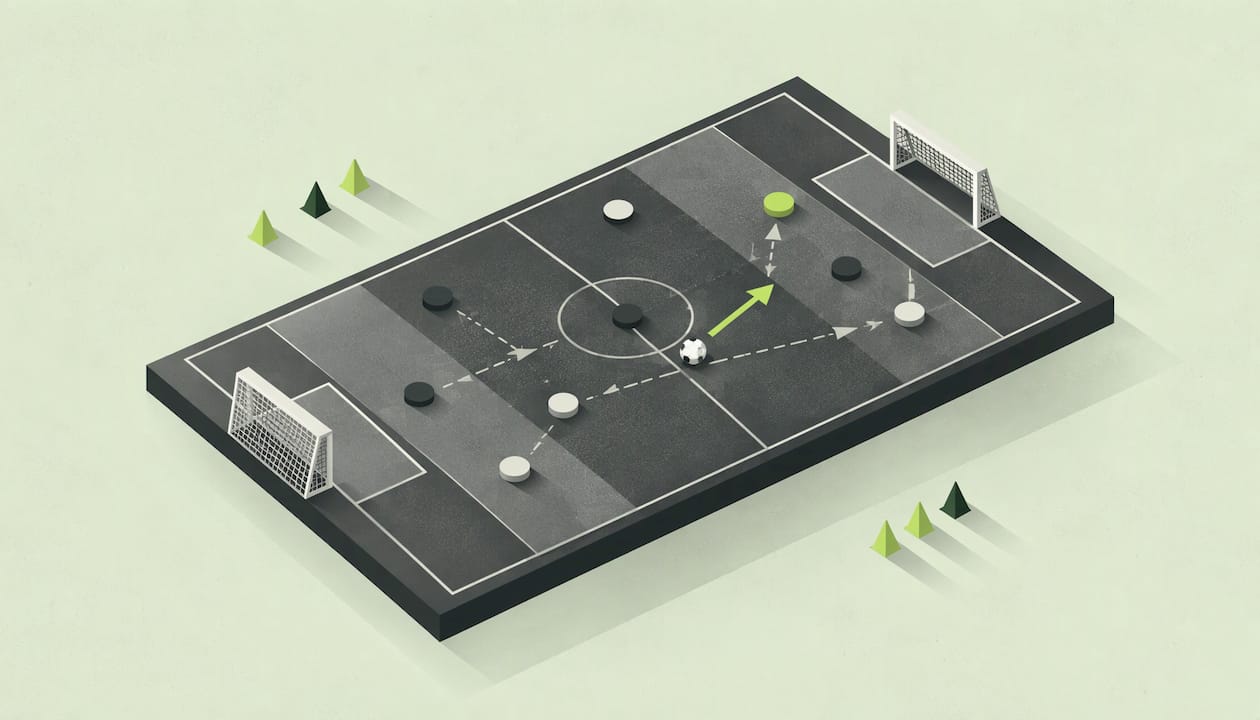
A small-sided game (SSG) is football with fewer players on a smaller pitch, and the format you pick decides what the players learn. Fewer players and tighter space mean more touches, faster decisions and more finishing. Bigger formats teach shape and team organization. This guide shows which format fits which goal, how to set the pitch, five games you can run tomorrow, and the coaching questions that turn a kickabout into training. We also built free practice plans and a 3D pitch for players who want to rehearse the same decisions away from the field.
TL;DR
- Use 2v2 to 4v4 on small pitches for touches, quick decisions and finishing. Use 6v6 and up on larger pitches for team shape and managing space.
- In one FA analysis of a 10-minute 3v3, each outfielder averaged 71 touches, against 57 in 5v5 and 37 in 7v7.
- Change one rule at a time (goals, touch limits, extra players) and let the problem teach. Ask questions before giving answers.
- Keep sessions game-like: few stoppages, a match for every player, and a progression from simple to structured.
- Rehearse the decisions off the field too with our Practice Club and 3D tactics pitch.
Table of Contents
- What small-sided games are and why they work
- Pick the format by the skill you want
- Set up the pitch, the numbers and the clock
- Five small-sided games to run
- Coach the decision, not the outcome
- Build a session, not a pile of games
- Practice the same decisions between sessions
- Adapt games for age, level and group size
- Common mistakes
- FAQ
- Sources
What small-sided games are and why they work
An SSG is a game played with reduced numbers on a modified pitch, usually with adjusted goals and rules. The point is repetition of real match moments: receive, scan, choose, act. In an 11v11 a winger might see a handful of crossing chances in a half. In a 3v3 every player is involved every few seconds.
The research backs the idea. A 2021 umbrella review of 12 systematic reviews found positive effects of SSGs on aerobic capacity and on tactical and technical behaviors. It also found that sex, age group, expertise, skill level and fitness status shape how players respond, so the same game will not hit every group the same way.
Canada Soccer's Small-Sided Games Guide (February 2026) says SSGs on modified pitches develop technical, tactical, physical and psychological qualities, with more ball touches, successful passes, dribbles and goal-scoring chances per player.
The same 2021 review describes SSG design as the management of task constraints: format and numbers, pitch configuration, scoring method, permitted actions, tactical missions and training regimen. That is a useful way to think. You are never just "playing a game". You are choosing constraints that make one decision happen again and again.
Pick the format by the skill you want
Start from the problem, not the drill. A 2020 systematic review of 37 articles found that smaller formats clearly increased technical actions compared with 5v5 up to 11v11, and that smaller relative areas increased most technical actions. The same review found that a one-touch limit raised involvements, errors and balls lost, so use touch limits sparingly and on purpose.
The 2026 umbrella review by Ulupınar and colleagues goes further: smaller areas with fewer players suit individual technical skill and quick decisions, while larger formats suit collective organization and managing big spaces.
| Goal | Format | Space idea | Why it fits |
|---|---|---|---|
| First touch, dribbling, 1v1 duels | 1v1 to 2v2 | Very small, mini-goals | Every player is on the ball constantly |
| Passing, finishing, quick choices | 3v3, 4v4 | Small, compact | Most touches and shots per player |
| Pressing, transitions, support angles | 4v4 to 6v6 | Medium, with a target at each end | Real numerical advantages appear and vanish |
| Team shape, switching play, lines | 7v7 to 9v9 | Larger, wide | Space has to be managed collectively |
| Match preparation | Larger SSGs | Closer to match space per player | Distances resemble a real game |
That last row has evidence behind it. Olthof, Frencken and Lemmink (2019) found that using 320 m² per player, rather than the typical area under 150 m², produced team running distances comparable to official matches in elite U13 to U19 players. If you want a session to feel like Saturday, give players Saturday's space.
In fitness terms, the 2026 umbrella review reports that aerobic strain shows up most often in 2v2 to 4v4 formats with roughly 100 to 150 m² per player, while maximal sprinting is rarely reached unless the area per player passes about 300 to 365 m². So a tight 4v4 builds work rate and decisions. A big, open game is where you find real sprints.
Set up the pitch, the numbers and the clock
Pitch area per player is the quickest lever you have. Take the total area and divide by the number of players on the pitch. If a 4v4 uses a 30 by 20 meter grid (600 m²) with eight outfield players, that is 75 m² per player: tight, fast, a lot of pressure. Stretch the same game to 40 by 30 meters (1,200 m²) and you get 150 m² per player, the top of the range where aerobic strain is most often reported.

Reference sizes from governing bodies
Youth associations publish formats you can borrow for training. The Jersey FA guidelines give a clear ladder:
- U6 to U7: 5v5 maximum, with 2v2, 3v3 and 4v4 recommended. Pitch 40 by 30 yards, size 3 ball, mini goals of 5 by 3 feet recommended.
- U8: 5v5, with smaller formats still worth considering.
- U9: 6v6 on 60 by 40 yards.
- U10: 7v7 on 60 by 40 yards.
In Australia, Football Victoria's MiniRoos guidelines list 4v4 on 30 by 20 meters, 7v7 on a quarter-size pitch (40 by 30 up to 50 by 40 meters) and 9v9 on a half-size pitch (60 by 40 up to 70 by 50 meters). Northern NSW Football's Regulation F sets U6 to U7 at four-a-side, no goalkeeper, a 2 by 1 meter goal and 20-minute halves.
These are match rules for young children, so treat them as starting points. For older or adult groups, use the area-per-player math above.
Practical kit and rules
- Cones or discs for the grid, two or four small goals, bibs in two colors, plus a third color if you add a neutral player.
- Spare balls at every goal so the game restarts in seconds.
- Blocks of 4 to 8 minutes with short rests. Short blocks keep intensity and attention high.
- Everyone plays. Canada Soccer's guide advises that players get to play a match every session, that coaches avoid stopping play too often, and that formats vary randomly between 1v1, 2v2 and 3v3.
Five small-sided games to run
These are simple designs built on the constraints described above. Adjust the pitch size to your players using the area-per-player idea.
1. 3v3 to four small goals
Two teams of three on a compact grid, with a small goal in the middle of each side. Teams can score in either goal at their end. Players have to scan, switch the point of attack and protect the ball, which trains decisions about where the space is. A coach can add a rule: a goal only counts after at least three passes.

2. 4v4 plus goalkeepers
A regular game with a keeper at each end on a pitch slightly longer than it is wide. It rewards finishing and gives defenders a reason to stay compact. The FA's 3v3 analysis noted that the format gave each outfielder seven finishing actions in 10 minutes, so you can expect shots to come in volume.
3. Target-player possession, 4v4 plus two
One target player at each end line, which the attacking team tries to find with a pass. It teaches playing forward through a press and then supporting the ball. Rotate target players every few minutes so they are not stuck.
4. Overload and transition, 4v3 into 3v4
One team attacks with an extra player until the ball is won or a goal is scored. The defenders that win it then counter into the other end with the numbers reversed. This trains the moment after a turnover, the hardest decision window in football: counter, hold or reset.
5. Wide-goal finishing game, 5v5
Place small goals at the corners of the end lines, rather than centered. To score, a team has to get the ball into wide areas, then cut inside or cross. The 2026 umbrella review notes that manipulating target numbers, such as using mini goals, helps teach field exploitation and lateral movement.
Coach the decision, not the outcome
The fastest way to waste an SSG is to coach every pass. Canada Soccer recommends problem-based coaching: set a realistic challenge, then ask guiding questions instead of prescribing the solution. Players then think for themselves, experiment and build confidence in their choices.
Use questions that name the picture, not the answer:
- "Where was the free player when you got the ball?"
- "What did you see before you received it?"
- "Which teammate could have given you an easier pass?"
- "If we lose it here, who is closest to the ball and who covers?"
Canada Soccer's guide ties in-possession play to decision-making, dispersal and support for teammates, and out-of-possession play to intercepting, marking, regaining, covering and pressing. Pick one or two of those as the theme for each game and keep your comments to it.
There is a long-standing example of keeping coaches quiet. The Manchester United 4v4 scheme, in Barry Stevens' account, was designed to recreate the park and playground games where great players first learned: plenty of time on the ball, freedom to try skills without ridicule, little pressure from adults. Coaches offered encouragement and praise for brave attempts and creative choices, rather than overt instruction during matches.
Two more evidence-based points help with shape. In Olthof's 2019 thesis, distances between players in SSGs were comparable to official matches (9 to 12 meters) regardless of team size, and a larger pitch gave more dispersion and more physical output. So you can teach spacing in small games, as long as you have room to spread out.
Build a session, not a pile of games
A good SSG session has a progression: simple at the start, more demanding as players settle in.
A model from Manchester United's 4v4 scheme
The Manchester United 4v4 festival, which the FA Premier League approved for under-9s in May 2002, rotates teams of four through four conditioned games: a goalkeeper game (4v4 plus two keepers), a two-goal game with large cones, a four-goal game with eight small cones, and a line-ball game. Each lasts 8 minutes, with no referees, no scores kept, a minimum of six games per player and at least a 2-minute break between games. It is a handy template for a rotating training session: change the scoring target, keep the players moving, take away the pressure of the result.
Canada Soccer's play spectrum
Canada Soccer describes four ways to pitch a game, and they make a natural session order:
- Unstructured play. Players make their own rules. A good opener.
- Guided play. You focus on an outcome and guide players who cannot see the solution.
- Structured play. Clear objectives and rules, kept simple and looking like football.
- Exploration play. Add or change a rule after each goal and ask players what they would change.
A 60-minute template
| Block | Minutes | Content |
|---|---|---|
| Warm-up | 10 | Free 2v2 or 3v3 with mini goals, no coaching |
| Theme game 1 | 15 | 4v4 with one constraint, such as wide goals |
| Rest and questions | 3 | Two guiding questions, one water break |
| Theme game 2 | 15 | Same theme, one new rule, such as a neutral player |
| Match-like finish | 15 | Larger SSG, such as 6v6 on a wider pitch, applying the theme |
| Cool-down | 2 | Short chat: what did you notice? |
If you coach a team that needs a plan that also covers several objectives without sacrificing match time, our guide on making one session work toward several objectives walks through it.
Practice the same decisions between sessions
Small-sided games give players the repetitions, but players also need to understand why a pass or a run works. That is where we come in. Touchline offers original tactical explainers, practice plans, interactive 3D visualization tools and progress trackers built around decision-making, and every guide is free.
Players who want to see the shapes from a SSG session can move the pieces on our interactive 3D tactics pitch. Our Practice Club offers seven sessions to understand your own game. If you want to review how your team holds its shape in the middle, read defend the middle before chasing the ball. For a way to rehearse breaking pressure, see our review of playing out of a press.

Our content is built around EA FC and FIFA, so players can test the same ideas, such as support angles and spacing, in the game as well as on the pitch. You can start at the Touchline home page.
Adapt games for age, level and group size
The same format changes character with the players in it.
- Young children. Keep formats at 2v2 to 4v4, with small goals and a small ball. The age-group guidance above supports small numbers for the youngest players. Avoid long waits and elimination games.
- Young athletes building fitness. A Brazilian narrative review reports that 3v3 on pitches from 20 by 25 to 27 by 36 meters and 4v4 on 30 by 35 to 30 by 40 meters, played three to five times a week for at least a month, seem to benefit young athletes' physical performance. It also notes that SSGs can be adapted to different performance levels and learning processes.
- Mixed ability. Use a neutral player or "joker" who always plays with the team in possession, which helps the team that has the ball keep it. The 2026 umbrella review says tactical behaviors are particularly sensitive to numerical balance, directional constraints and joker use, so a single change like this can shift the whole game.
- Odd numbers. Play 3v2 or 4v3 with a rotation: the team that wins the ball sends a player off, and the losers add one. This keeps everyone moving.
- Adults and older teens. Use larger areas per player, add keepers and full-size goals, and tie the game to the match plan.
The 2026 review also frames the whole task as a matrix: spatial density and player format drive responses, and rule changes can substantially raise internal load and game intensity. If players are exhausted too early, remove a rule before you shorten the game.
Common mistakes
- Too many stops. Every whistle takes away the game. Let play run and coach in the gaps.
- Too many rules at once. Change one constraint, watch what happens, then add another.
- Overusing touch limits. The 2020 review shows that one-touch rules lift errors and lost balls, so use them for a short block and for a reason.
- Pitch too big for the theme. If you want quick decisions, shrink the area. If you want sprints and switches, widen it.
- Waiting players. Four teams on one pitch means long queues. Use two pitches or shorter blocks.
- No link to the match. End with a larger game so the theme shows up in a realistic setting.
FAQ
What is the best number of players for a small-sided game?
For technique and quick decisions, 3v3 or 4v4 gives the most involvement per player. The FA reports an average of 71 touches per outfielder in a 10-minute 3v3, against 57 in 5v5 and 37 in 7v7. Use larger formats when your focus is team shape.
How big should the pitch be?
Divide the total area by the number of players. Aerobic strain is most often reported at about 100 to 150 m² per player in 2v2 to 4v4 formats, per the 2026 umbrella review. Go above about 300 m² per player if you want players to reach top sprint speed.
How long should each game last?
Short blocks keep intensity up. The Manchester United 4v4 scheme uses 8-minute games with at least a 2-minute break between them. Many coaches run 4 to 8 minutes with a rest and a question in between.
Do small-sided games work for adults and older players?
Yes. The umbrella reviews cover players of different ages and levels, with sex, age, expertise and fitness shaping the response. Use larger areas per player and more match-like rules as the group gets older.
How do small-sided games improve decision-making?
Players face the same type of choice many times in a short period, with real opponents. Coaching with guiding questions, as Canada Soccer recommends, helps them think through those choices instead of waiting to be told what to do.
Sources
- Small-sided games: An umbrella review of systematic reviews (Clemente, Afonso and Sarmento, 2021)
- Canada Soccer Small-Sided Games Guide (2026)
- The effects of small-sided soccer games on technical actions (2020 systematic review)
- Why you should try 3v3 small-sided games (England Football Learning)
- An umbrella review of soccer small-sided games (Ulupınar et al., 2026)
- Jersey FA Foundation Phase 5 to 11s guidelines
- Football Victoria MiniRoos Guidelines
- Northern NSW Football Regulation F
- A match-derived relative pitch area (Olthof, Frencken and Lemmink, 2019)
- Small-sided games in youth soccer (Olthof, University of Groningen thesis, 2019)
- Manchester United 4v4 scheme (Barry Stevens, 2002)
- Proposals and effects of training using small-sided games (Brazil, 2021)